Context
01Problem
The HCI design department launched when I joined, branching off from the UX development team. I was the first HCI lead hire on a newly formed team that also included a designer, a front-end developer, and a project manager.
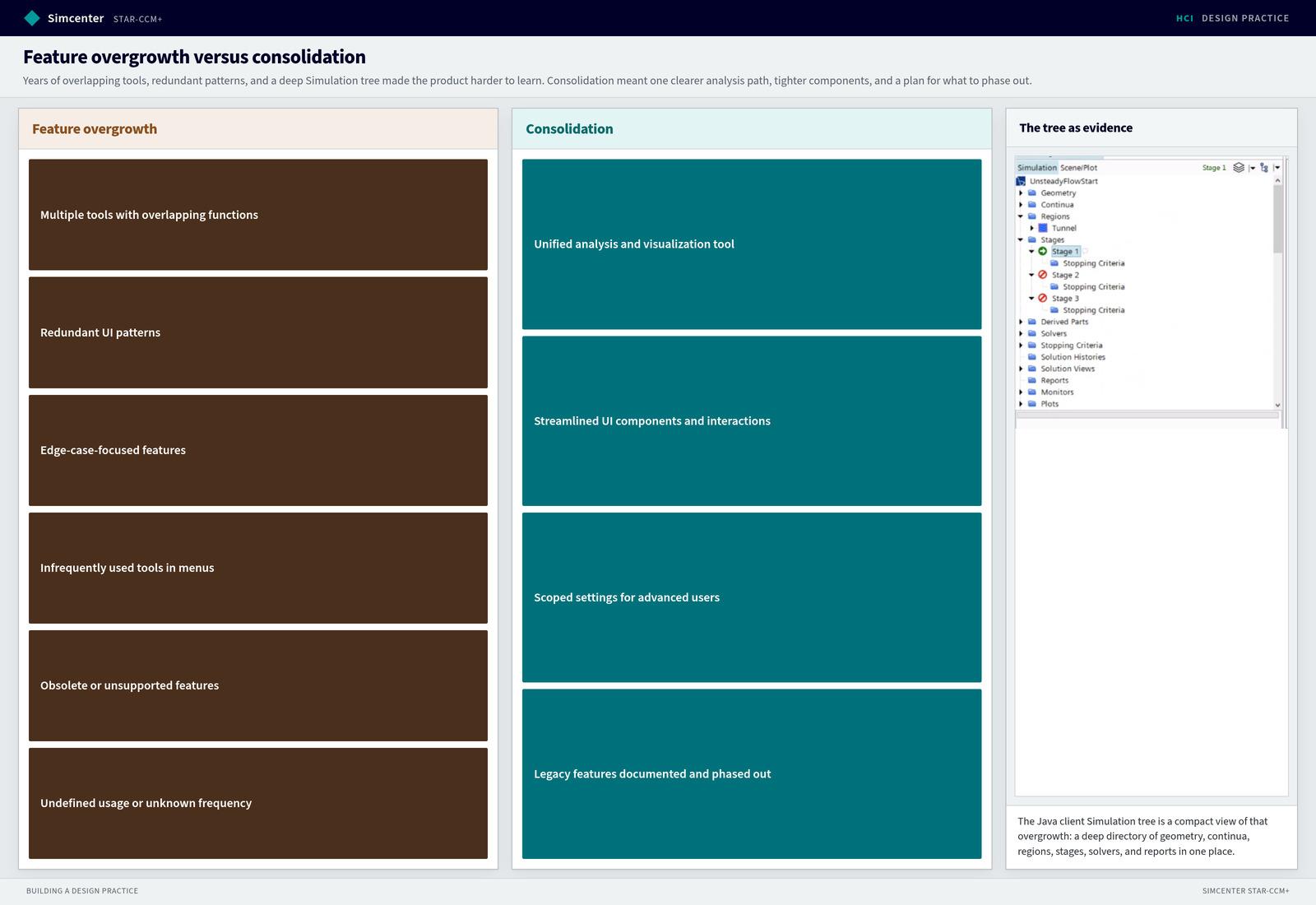
The STAR-CCM+ interface was powerful and notoriously dense, buried under tree directories, and it had not evolved much in nearly 20 years. Engineering was skeptical of human-centered methods, particularly those from the Nielsen Norman Group. The culture assumed PhD users could absorb the complexity, and I was an outsider in a first HCI-lead seat. Teams worked in silos, with limited cross-functional collaboration.
The HCI team sat under the development banner. Years earlier, a guardrail had been put up that barred developers from speaking to customers, to prevent scope creep and feature bloat. Product Management were the only customer touch points. Direct research, observation, and interviews were off limits.
When the manager took a leave of absence a few months in, there was no one else clearly carrying the practice. The research and the Next Gen work still had to move.
02Opportunity
I stepped in as acting manager for 18+ months, reporting to the director and senior management. I worked with the project manager and the director to solidify a plan, and I kept a small team focused on research.
I moved us from abstract concepts to visual overlays on the existing Java client, so engineering could see the work as actionable, not theoretical. That is how trust with engineering started to stick.
We kept the research moving with the support team and with new hires, often by shoulder-surfing expert users who were new to the company, the same approach I used when a cultural barrier kept me from reaching actual customers on the A to Z workflow. That progress showed leadership how we would approach customers, and it gave them the confidence to grant HCI direct access for research, observation, and interviews.
I ran 12 weekly lunch-and-learns with four software developer cohorts, and I directed a research program with four weekly customer research meetings, which cut product scope by 30% per sprint. Nielsen Norman methods, feedback loops, and collaboration were how I kept building that trust. Over time, engineers started pulling me into technical discussions, not just design reviews. I was promoted in 2020 for embedding UX in the product lifecycle and improving cross-team collaboration.
03Constraint
The HCI team sat under the development banner. Years earlier, a guardrail had been put up that barred developers from speaking to customers, to prevent scope creep and feature bloat. Product Management were the only customer touch points.
I was a first HCI lead in a PhD-heavy shop that treated UX as an outsider, then an acting manager of a small team, reporting above the original manager seat, without a long runway to pause the work. Research had to earn trust with data and a disciplined approach, not with a redesign pitch. Until leadership granted access, we could not go directly to customers.
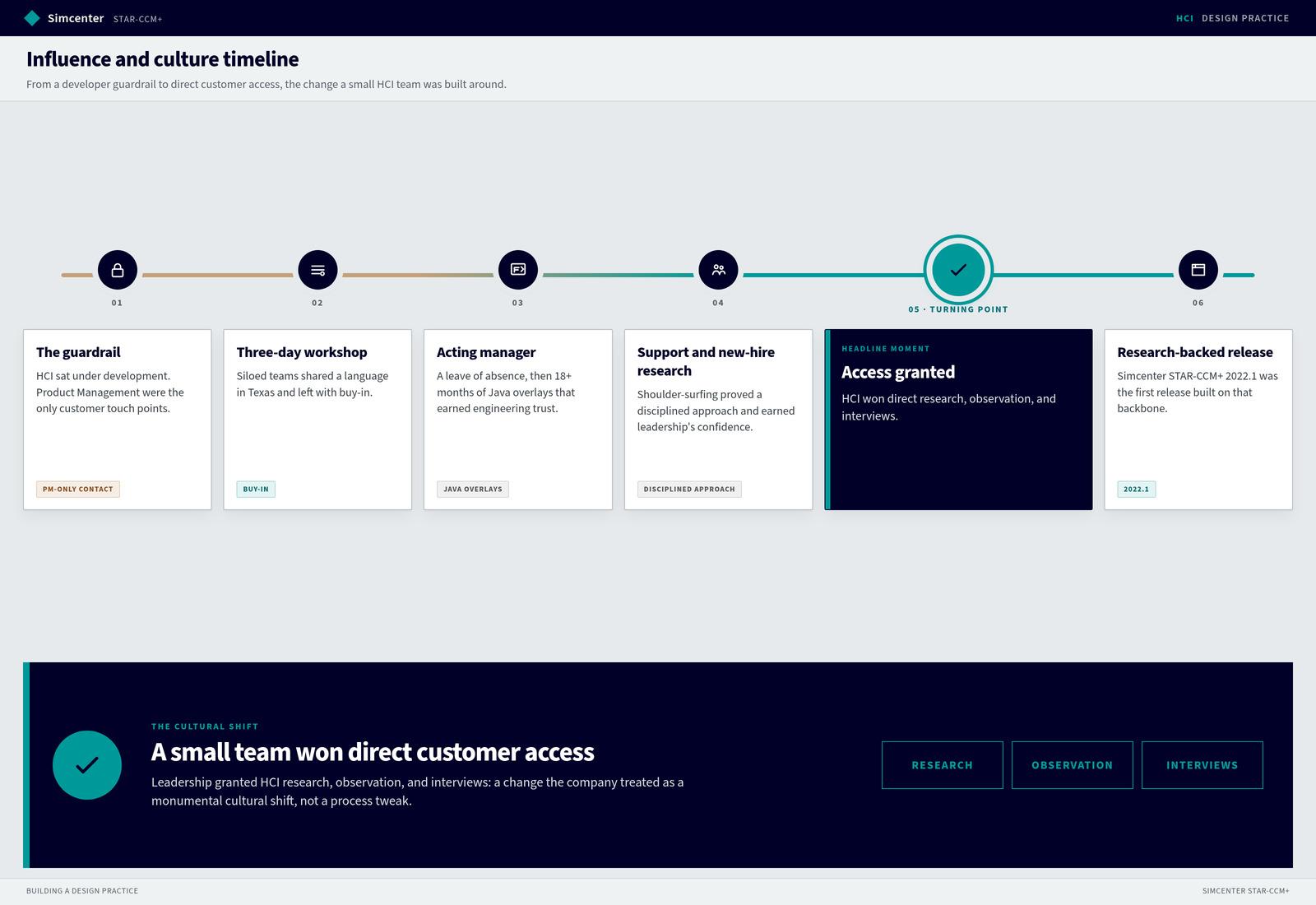
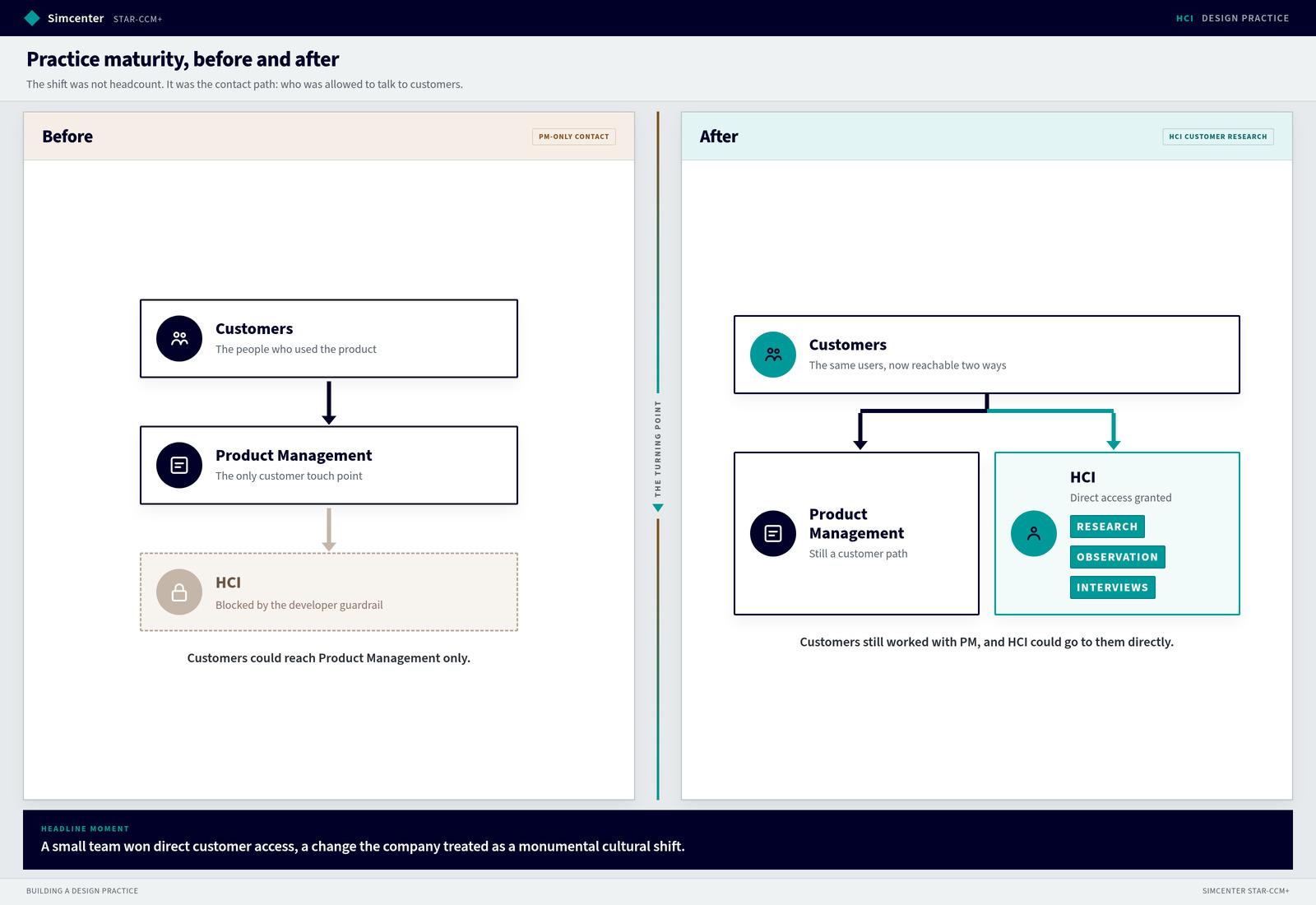
A small team won direct customer access for research, observation, and interviews, a change the company treated as a monumental cultural shift.
Approach
- Stepped in as acting manager of a small team and kept the research moving with support and new hires.
- Used Java-client visual overlays, lunch-and-learns, and weekly research meetings to earn trust and cut scope.
- Won direct customer access for research, observation, and interviews.
Outcomes
- A small team won direct customer access for research, observation, and interviews, a change the company treated as a monumental cultural shift.
- With that access, we boosted user retention by 33%, reduced QA churn by 20 to 25% and new feature bugs by 8 to 12%, and doubled on-time feature delivery.
- When I left, the director told me the research and design systems would keep guiding the product, and Simcenter STAR-CCM+ 2022.1 was the first release built on that research backbone.
Reflection
A small team won direct customer access, a change the company treated as a monumental cultural shift, and Simcenter STAR-CCM+ 2022.1 was the first release built on that research backbone.