Context
01Problem
After Context Optional and Efficient Frontier joined Adobe, enterprise customers were waiting six months to go live. Early on, communications and timing with the offshore team frequently broke.
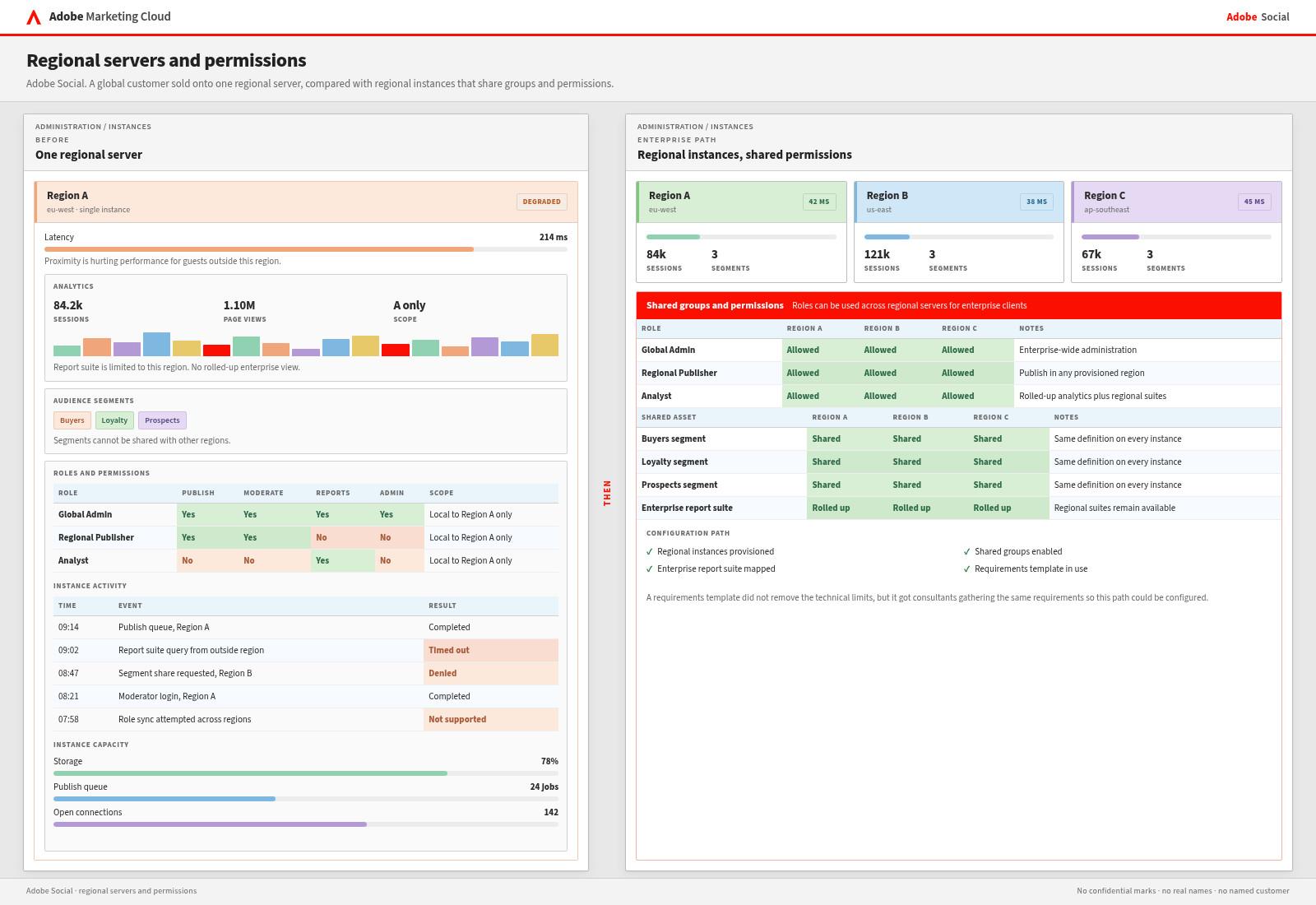
Sales did not always align with the technical requirements. In one case, sales sold a large global customer onto an instance on a single regional server. We learned that regional server proximity affected performance, and that regional analytics, segmented audiences, and the grouping of roles and permissions also needed to live at a regional level.
02Opportunity
Templatizing the onboarding requirements did not resolve those technical problems. It did make sure every consultant retrieved the same requirements, in the same vernacular, so the offshore technical consultants could configure the work more efficiently.
As the consultants' advocate and requirements voice, I worked with the technical team on some of the identified restrictions, so groups and permissions could be shared across regional servers for enterprise clients. The onboarding model had to get customers live in two weeks, not six months, and actually adopted once they were standing.
03Constraint
Regional server proximity, regional analytics, segmented audiences, and regional roles and permissions were real technical limits. A template could not erase them, and sales could still sell ahead of them. I could bring those restrictions to the technical team as a consultant. I did not own the product, so I could not change those limits on my own.
Approach
- Templatized onboarding requirements so every consultant retrieved the same requirements, in the same vernacular.
- Worked with the technical team so groups and permissions could be shared across regional servers for enterprise clients.
- Took the most complicated setups, the largest customers, and the at-risk contracts.
Outcomes
- Cut Adobe Social go-live from six months to two weeks (10 business days), and boosted user adoption by 25%.
Reflection
A template could not erase regional limits. It could make every consultant ask for the same requirements, so customers could go live in two weeks and actually get adopted.